
Runoff Control Using a Rainfall Simulator
As our cities grow, more streets, parking lots, and sidewalks are covered with hard surfaces that don’t let rainwater soak into the ground. This leads to more flooding, especially during heavy storms, because water has nowhere to go but the streets.
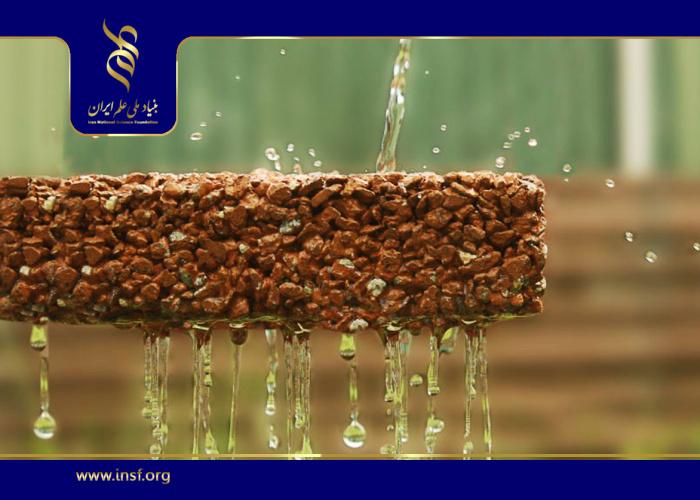
To solve this, scientists and engineers have been working on permeable pavements — special types of ground surfaces that allow rainwater to pass through them and into the soil below. But traditional permeable pavements (like porous concrete) can clog up over time, and they’re not strong enough for heavy traffic in some areas.
A research team at Semnan University, lead by Prof. Hojtat Karimi and Dr. Alireza Rezaei, and funded by Iran National Science Foundation (INSF), studied a new solution called Clogging-Resistant Permeable Pavement (CRP). They wanted to check if CRP handle rain better than older types of permeable pavement.
Using a specially designed rain simulator, the team tested how CRP and another pavement type — Permeable Interlocking Concrete Pavement (PICP) — performed under different conditions, such as light and heavy rain, gentle and steep slopes and partial or full pavement coverage. They
Beyond the physical tests, the researchers used artificial intelligence (AI) to build models that could predict how much runoff would occur based on different weather and pavement setups. The best results came from a combination of AI methods known as SVM-BA — which uses both machine learning and a bat-inspired optimization technique.
The results showed that the Clogging-Resistant Permeable Pavement (CRP) clearly outperformed the older Permeable Interlocking Concrete Pavement (PICP), particularly during heavy rain and on steeper slopes. Increasing the proportion of permeable surface area reduced the overall volume of runoff and slowed down the rate at which water built up on the surface. Even under conditions where traditional pavements began to clog and lose effectiveness, CRP continued to perform well.
The research also proved the value of artificial intelligence in urban water management. The AI model developed in this study could predict runoff behavior with high accuracy, reducing the need for repeated physical testing and saving both time and money in future projects.
Flooding is more than just an inconvenience — it can cause serious damage to roads, homes, and community infrastructure. CRP pavements provide a strong and lasting solution for reducing flood risks in urban areas. Combined with AI-based prediction tools, they make it possible to design and plan drainage systems more efficiently and with greater confidence.
 Soroush